Why Most Campaigns Fail Before They Launch
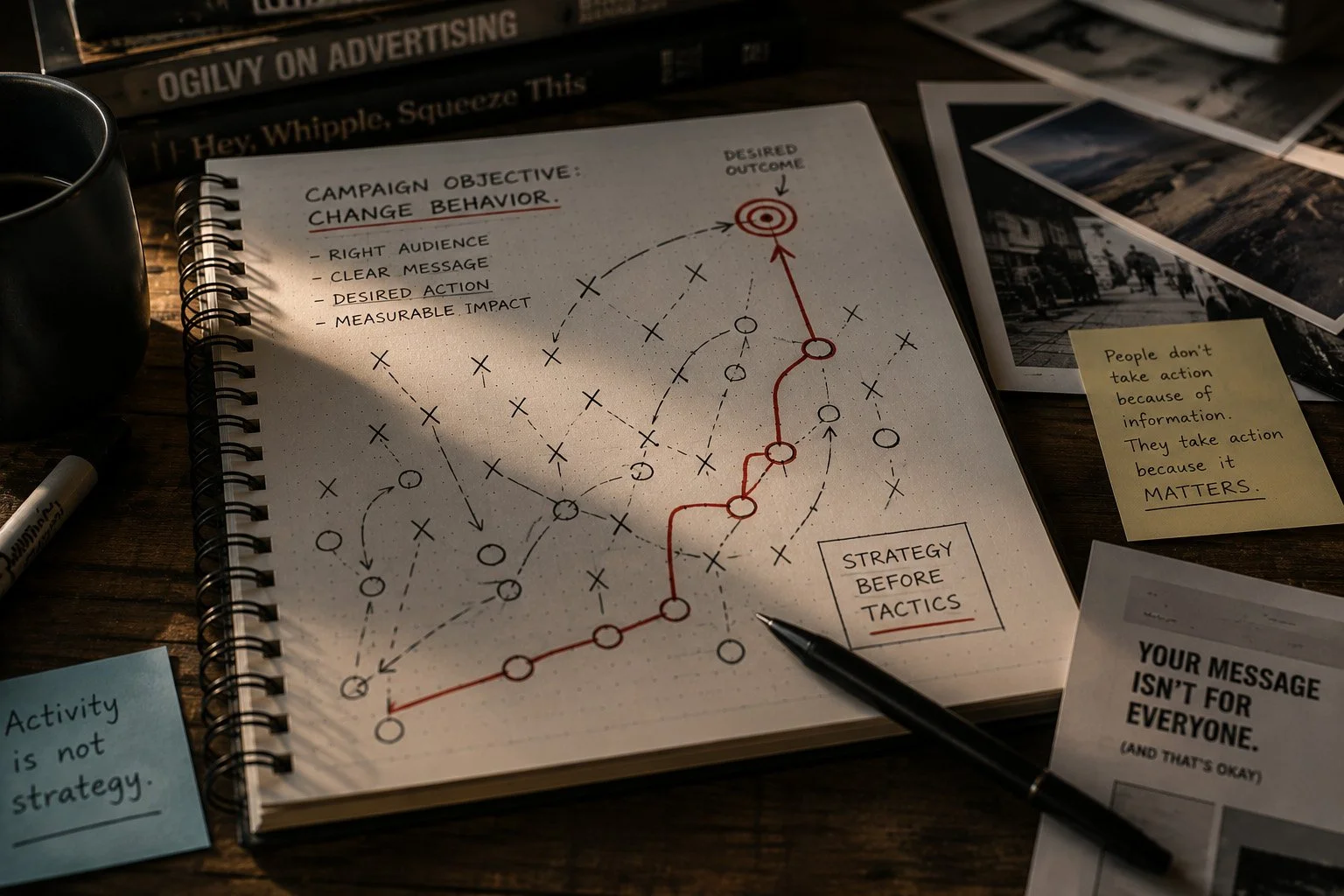
Strategy determines what creativity can achieve
One of the biggest misconceptions in marketing is that campaigns succeed because of creative execution. Organizations spend enormous amounts of time discussing logos, headlines, videos, photography, advertising placements, and social media content. While those elements matter, they are rarely the reason a campaign succeeds or fails. After years of developing campaigns for healthcare organizations, nonprofits, businesses, and community initiatives, I've become convinced that most campaigns succeed or fail long before the first advertisement is placed or the first social media post is published.
The problem is usually not creativity.
The problem is strategy.
I've sat in meetings where teams spent hours debating taglines, colors, and creative concepts without first agreeing on what the campaign was actually supposed to accomplish. Were we trying to increase awareness? Drive participation? Improve recruitment? Increase donations? Encourage screenings? Change behavior? Without clear answers to those questions, even outstanding creative work struggles to produce meaningful results. The campaign may generate attention, but attention alone is not the same thing as impact.
Activity is not strategy
Many organizations begin campaign planning by focusing on deliverables. They want videos, social media content, advertisements, email campaigns, media coverage, brochures, or website updates. Those tactics are important, but they are not strategy. Strategy answers a different set of questions. Who are we trying to reach? What action do we want people to take? What barriers currently exist? How will success be measured? Until those questions are answered, campaign activity can quickly become disconnected from campaign objectives.
Throughout my career, some of the most successful campaigns I've worked on were not necessarily the largest or most expensive. They were the campaigns where everyone involved understood the objective from the very beginning. Creative decisions became easier because the strategy was clear. Messaging became stronger because it was aligned with a specific outcome. Every tactic supported the same goal.
Great campaigns focus on behavior
One lesson that continues to shape my thinking is that effective campaigns rarely exist simply to distribute information. They exist to influence behavior. A healthcare campaign may encourage preventive screenings. A recruitment campaign may encourage qualified candidates to apply. A fundraising campaign may encourage donors to contribute. A community initiative may encourage participation or engagement. While the desired outcome changes, the underlying principle remains remarkably consistent.
People rarely take action because information is available. They take action when communication feels relevant, meaningful, and connected to a need they already recognize. That's why audience understanding is often more important than creative execution. The better an organization understands its audience, the more likely it is to create communication that resonates and produces results.
Consistency outperforms novelty
Organizations often search for the perfect campaign idea. In reality, consistency usually matters far more than novelty. Audiences are exposed to thousands of messages every day. Most are forgotten almost immediately. Effective campaigns recognize this reality and focus less on constant reinvention and more on repetition.
Some of the most successful campaigns I've been involved with were not built around groundbreaking creative concepts. They succeeded because the message remained focused, consistent, and visible over time. Every communication channel reinforced the same core idea. Every tactic supported the same objective. That consistency created momentum and produced results that no single advertisement or social media post could have achieved on its own.
The bottom line
Most campaign discussions begin with creative ideas. The strongest campaigns begin with strategic questions.
Before discussing logos, videos, graphics, advertising, or social media, organizations must understand what success looks like and how the campaign will contribute to achieving it. They must understand the audience, define the desired outcome, and establish a strategy capable of guiding every decision that follows. When those elements are missing, campaigns often become collections of tactics searching for a purpose.
In my experience, the best campaigns are rarely the ones that attract the most attention. They are the ones that produce the most meaningful results because every creative decision is connected to a clear objective from the very beginning.